Sunday, March 11
A Wrinkle in Time
“A Wrinkle in Time” was first published in 1962. That’s a long gestation period for a novel to find its way to the silver screen, but perhaps the digital and visual effects have finally caught up with Madeleine L’Engle’s epically visionary story. I remember struggling to read it when I was young; it was a bit too abstract, and I couldn’t quite follow the thematic nuances that the author was conveying in deep, sometimes allegorical layers.
Middle schooler Meg (Storm Reid) and her brother, Charles Wallace (Deric McCabe), are adjusting to life without their brilliant scientist father, Mr. Murray (Chris Pine), who mysteriously vanished four years prior. Their grieving is met with an almost cruel dismissal by everyone they encounter, leading them to close themselves off from relationships. Never giving up hope of a reunion, the enigmatic and precocious Charles Wallace conjures the visitation by three transcendental cosmic beings; Ms. Who (Mindy Kaling), Ms. Whatsit (Reese Witherspoon), and Ms. Which (Oprah Winfrey). With their tagalong friend, Calvin (Levi Miller), the three children embark on a fantastic journey to find their estranged father, where space and time are somehow both ubiquitous and non-existent.
At the corner of science and fantasy, “A Wrinkle in Time” is quite a trip. Never delving too deeply into the science (it is Disney after all), it is more a call to arms by a female director and an almost exclusively female cast to encroach on the traditionally male-dominated market. Disney has always been a bit ahead of the curve in terms of female protagonists, and Storm Reid holds her own surrounded by veteran actors and a media titan. I applaud the movement in Hollywood, which was clearly prevalent in the recent “Annihilation” as well (fantastic film by the way). We are witnessing the dismantling of a patriarchal industry, and it’s exciting to see what’s on the horizon.
Director Ana DuVernay (“Selma”) enlists writer Jennifer Lee (“Frozen”) to bring to life in a very feminist version of the novel, and it works to an extent. I appreciated the bold liberty taken in modifying aspects of the story (Meg’s two twin brothers are removed entirely) but the story doesn’t seem to move in a very traditional fashion. There are simply too many sequences that just take the audience to the next beautiful scene without much thought of context or reasoning. The narrative moves through stages of the hero’s journey without much fanfare or sense, but the imagery is stunning and lighthearted. By the time the climax nears however, there is a marked shift in tone, which I found to be a bit extreme in contrast to my expectations. It left the playful mood behind and jumped into the deep end of a dark, ominous nightmare.
Too scary for PG, and too childish for PG-13, I’m afraid the film finds itself in the twilight zone of demographic targeting. It’s a kid’s movie with far too much bite, but it is decidedly still a kid’s movie. For that, I had a hard time enjoying the ending. I can’t recall exactly how closely the film followed the book’s narrative, but it lacked the comfort of any sort of familiarity for certain. I’m sure it will do well at the box office with a modest $100 million budget and a strong marketing campaign, but I have to say I was less than thrilled with the outcome.
“A Wrinkle in Time” is yet another classic young adult book riding the coattails of its reputation in novelization form. You might enjoy the film if you’re a child; wait, you’ll be frightened by the ending. You won’t quite enjoy it if you read the book when you were a child yourself and seeking some nostalgia either. Maybe there is a sweet spot, like if you are a 12-14-year-old advanced reader? Otherwise it’s fine to miss this one. 5/10.
Saturday, March 3
Red Sparrow
The anticipated Russian thriller reuniting Jennifer Lawrence with director Francis Lawrence (no relation) was bumped from the primo Oscar release timeframe of late November to early March, which always creates a bit of apprehension about the studio confidence. Lawrence has been out of the spotlight recently, appearing in last October’s “Mother!” which drew critical ire, but I actually really enjoyed the allegory, as abstract as it was.
Lawrence plays Domenica, a young ballerina who is forced into a deep cover spy program when a leg injury shatters her career. The program quickly transforms her into a “sparrow” or a vamp who uses sexuality to gain trust and information. She forms a bond with CIA operative Nate Nash (Joel Edgerton), but there is very little cat-and-mouse as they simply don’t have any chemistry and there is absolutely no mystery or intrigue to their relationship. As she falls deeper in the spy game rabbit hole, the danger becomes real and it isn’t until the lackluster final scene that we truly understand her real motives.
I was a bit stunned by the blatantly sexualized characterization of one of Hollywood’s hottest young starlets with an already impressive resume under her belt. At this point in her career, she has her pick of projects, so this one seemed a bit counter-intuitive. There is a confused message of feminism and male domination rolled up in a cliché ball of pretentious wannabe sophistication. It is cliché, it is not sophisticated.
The story fumbles with a couple of severely neglected plot points, and predictable linear progression while taking far too long. By the time the inevitable twist arrives, the audience is far too bored to appreciate the attempt at cinematic novelty. Simply put, the story is weak and lacks originality.
It lacks the punch of last year’s “Atomic Blonde” while trying desperately to land the tone of 2007’s fantastic “Eastern Promises.” There is certainly a whiff of “Basic Instinct” not just in the shocking gratuitous nudity, but in the early 90’s quality of filmmaking. That’s not to say there’s anything terribly offensive about the direction or cinematography, but the film could have done much, much better (as could have J-Law).
The one bright spot for me was Joel Edgerton’s Nate Nash. The character lacks any depth, but his attitude and carefree demeanor somehow works. He’s cool, confident, and plays a spy far more effectively than Lawrence’s Domenica, which is disappointing. The supporting characters played by Matthias Schoenaerts, Charlotte Rampling, Ciaran Hinds, and Jeremy Irons are all emotionless and, well, Russian, but there is nothing that stands out by any of their performances, which is a surprising shame since they are all very accomplished actors.
Amidst the Russian collusion hype and nuclear armament, the idea of espionage with our Cold War rival has an eerie verisimilitude, but this particular story lacks any teeth. There is no reason to care about the characters or the events, and for that I fault the screenwriter, Justin Haythe (“Revolutionary Road,” “The Lone Ranger”). Francis Lawrence is to blame for allowing the film to degenerate to the extent it did, but I imagine that it seemed like a good idea at the time.
With an A-list star on full display (literally), I expected more (and less) out of Jennifer Lawrence. She is talented and attractive, but her Russian accent leaves much to be desired. The film is colder than Siberia, and is simply not enjoyable, even if you try. 4/10.
Saturday, February 24
Game Night
The timing seems just right for a smart comedy to hit theatres. I was just thinking that it’s been a while since I’ve had a good laugh in the theatre. Fortunately, there is more depth and story to this one than you might expect, and notably strong characters (a fantastic cast as well). Warner Bros. has the action-comedy market cornered ever since “Horrible Bosses” in 2011. “We’re the Millers,” (2013) and “Central Intelligence” (2016) brought in well over $100 million each, and I would expect that “Game Night” will follow suit (unless everyone just keeps going to “Black Panther”).
Max (Jason Bateman) and Annie (Rachel McAdams) are an uber-competitive couple bonded through their love of all types of games. The opening montage shows their meet-cute, and the evolution of their love story from trivia night to a charades proposal and a Dance-Dance-Revolution wedding reception. It’s a bit much, but we get the point, and they are actually a pretty cute couple. They host weekly game nights, and seem to have a pretty good life (without the depth of knowing their careers) when things get a bit out of control. Max’s Brother, Brooks (Kyle Chandler) comes to town and introduces them to a whole new game. From there, it’s a mix of mystery and action, but always grounded with sharp comedy.
John Francis Daley (“Freaks and Geeks,” “Horrible Bosses”) is one of the creative minds behind the film, and besides being a nice guy in real life (no big deal, I met him once), he once again shows that he is in fact one of the stronger writers in the action/comedy genre. It doesn’t hurt that he has Jason Bateman to work with either. Directing “Game Night” isn’t a challenge, but he does manage to keep the audience’s attention by moving the story along at a nice pace.
Bateman and Chandler are fantastic as the brothers, but I tend to enjoy most anything they do. “Arrested Development” and “Friday Night Lights” are both up there in terms of all-time favorite shows, and they both just seem so natural and cool on screen, it is very entertaining. McAdams has been out of the spotlight since, well, “Spotlight” but returns light-hearted and with remarkably strong chemistry with Bateman.
Jesse Plemons completely steals the show as Gary, the no-nonsense police officer neighbor who so desperately wants to be a part of game night. His lines are delivered with an almost uncomfortable precision, and his posturing and visage is an uneasy blend of aggression and rigidity, but that makes it all the more hilarious. His Bichon Frise accessory, Bastian, adds to the absurdity of his character, but surprisingly he serves as an anchor for the film.
Michael C. Hall makes a rare surprise cinematic appearance as well, which is a nice touch since his “Dexter” ship sailed off in a lackluster fashion. Jeffrey Wright (one of my all-time favorites; get this guy some leading roles, please!) leaves his mark on the film in a brief but intentionally exaggerated role, and it’s fantastic as well.
There is a lot to like about this film. Maybe it’s the ripe timing of its release, and maybe it’s the strong cast. The story itself isn’t anything we haven’t seen before; unsuspecting participants in a real kidnapping mystery, thinking it’s a game then finding themselves entangled in the subsequent chain of events. But that’s not the point. The point is pure fun. Bateman has proven that he’s got dramatic acting chops, but comedy is his wheelhouse, and I for one will continue seeing his work. Skip game night, and go see “Game Night.” 8/10.
50 Shades Freed
Just in time for Valentine’s Day is the finale we’ve been collectively holding our breath for is finally here. The climax to the most unlikely literary success since the Twilight franchise. Will Ana and Christian live happily ever after in their naughty billionaire Seattle fantasy world? Will generic antagonist Jack disrupt their perfect bondage-clad, masochistic world? Will Christian’s wandering eye spark a jealous rage by his new bride? You have to find out for yourself during date night. Or not.
The film begins with the wedding, creating some irony in the title. The bachelor of the century is finally off the market but can he change his primal ways? The pair struggle to navigate married life, finally have the discussion about children (a bit late, isn’t it?), and face off against both of their past demons with some passionate relations sprinkled in, spending lavish amounts of money on adventures and luxuries while pretending to have careers of their own.
Jamie Dornan and Dakota Johnson remain simply acceptable in the roles. Johnson actually steps up to add a bit more depth to the character that was missing from the first two films, but that might be the result of slightly sharper writing and faster-paced direction. She didn’t bother me as much as she did in the first two films, but I still don’t see what Christian sees in her. Dornan was mis-cast from the start. Nothing more than brooding eye candy, the audiences will swoon but he’s not going to win any awards that aren’t named after a deep red berry.
Director James Foley (“Glengarry Glen Ross,” “50 Shades Darker”) improves slightly on the sequel from last year. Maybe the bar has been lowered, or maybe my perspective has softened after seeing the first two films. Either way, this one is a bit refreshing and some of that success has to be attributed to the director.
The thing I’m reticent to share is that I bought into the hype. I read all three novels in a fairly short amount of time, and found myself waiting for something good to happen as I criticized the poorly-constructed narrative. The sixteen hundred pages came and went without arousing any literary satisfaction on my part, yet I have to commend E.L. James for pulling a Rowling and staking nearly one hundred million dollars on amateur female erotica. Well done, E.L.
As I sat in the cold, dark theatre, surrounded by overly-excited women (I was literally the only person in the room ….) I began to suspect that I wasn’t the target demographic for this film. But what I keep wondering is what the real appeal is. The film isn’t well-done, the actors are pedestrian and perhaps even mis-cast in the first place, but then it struck me. “Pretty Woman,” “Cinderella,” “Twilight,” and even Disney’s “Sophia the First” (I have a 3 year-old). They all carry this fantasy theme of a normal girl plucked from obscurity by a wealthy, suave, handsome man. It’s the fairy tale. But the wrinkle is the deep-rooted flaws in Christian Grey, so Anastasia not only gets her happy ending, but she gets an opportunity to fix an emotionally broken man. Two birds with one stone!
“Fifty Shades Freed” is not a good film by any stretch of the imagination, but it is better than its predecessors. Maybe the relief of knowing that this cultural phenomenon has reached its climax will help us all forget that it happened in the first place. 5/10.
Sunday, February 18
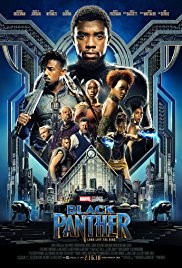
Black Panther
2018 is going to be a busy (translate = profitable) year for Marvel Studios. Television notwithstanding, “Black Panther” is the first of eight scheduled films that should introduce us to new heroes, villains, and visual effects that will certainly leave audiences in awe. Granted, not all eight fall within the Marvel Comics Extended Universe, but they are all Marvel character vehicles nonetheless.
“Black Panther” picks up where “Captain America: Civil War” left off; T’Chala (Chadwick Boseman) is returning to his home of Wakanda, Africa to assume the throne of his people after the death of his father. A beautiful land shrouded in mystery and isolation, its people live in this juxtaposition of tribal heritage and technological advancement. T’Chala struggles with his desires to help the greater good, while his inner circle begs him to refrain from exposing their utopian society. When his crown is challenged by Erik “Killmonger” Stevens (Michael B. Jordan), their whole existence is threatened and T’Chala must rise to meet the demands of a king.
Ryan Coogler (“Creed”) delivers a demographic-crossing blockbuster with the ease of a veteran film maker. Hot on the heels of “Wonder Woman” and its feminist ceiling dismantling, we are seeing a revolution in the industry as he’s poised to become the first non-white man to shepherd a film across the global billion-dollar mark (that’s right, I’m calling it now). He displays deep thematic allegories through the fantasy of an action film; colonization, racial dominance, humanity, tribal allegiance, and of course, good versus evil. The beauty and magic is that his version of evil is a concoction of the most empathy-invoking villain we’ve seen in the MCEU yet. More on that later.
Chadwick Boseman is outstanding, and adds significant depth to the character that was established in “Civil War.” He breezes through the film with a confident, fierce look and his dialogue unravels his motives more and more, creating what may be the face of the Avengers franchise once the Infinity War is over.
Michael B. Jordan plays the antagonist, Killmonger, with an absolute heartbreaking edge. At first it seems that he is simply an urban kid from Oakland with a grudge, but as the character develops, his motives are pure and understandable with a deep-seeded hurt that you can feel every time he speaks his mind. I liked him more and more as the film went on, and I only wish he had more screen-time. I’ve said it before, a man versus man conflict is only as good as the villain. It’s what makes or breaks the film, and “Black Panther” hit it right on the mark. Jordan is tremendous. Surrounding the two stars is an impressive collection of actors (Forest Whitaker, Lupita Nyong’o, Daniel Kaluuya, Danai Gurira, and Letitia Wright) who bring strong performances all around. Andy Serkis and Martin Freeman play the token white men (never said that before), and Serkis is entertaining as usual, but it’s strange to see him in the flesh and not as Gollum, an ape, or a “Star Wars” creature.
Since it is the last entry before the highly anticipated “Infinity War,” I was disappointed in the post-credit scene. I think this is an area Marvel has lost their edge significantly. It was predictable if you’ve seen the other films, and just might be an Easter egg for what’s coming in the next film, but it was a bit too brief. I have a theory, but won’t bore you here. Okay, Captain America is going to die. There, you have it.
The visual effects are stunning as usual, and Coogler gives us a fresh avenue for future films, and I’m generally very impressed. My two main complaints, however nitpicky, are that the love interest, Nakia (Nyong’o), never really develops much chemistry with our hero. They fizzle when on screen together, and that may be the point but I truly wanted more in that relationship. Also, the film spends a lot of time setting up the tone and feels a bit slow at times. Minor complaints for an incredibly strong film that has such high expectations. I can’t wait to see T’Chala again in May. 9/10.
Monday, January 29
Hostiles
The Western genre is a beautiful thing when done well. You have to sift through the cheesiness and cliché to find the good stuff, not unlike panning for gold, but there is something romantic and raw about the right portrayal of the American southwest in the late 1800’s. As a huge fan of Cormac McCarthy, I find there is an appeal to the brutality and simplicity of frontier life that is almost primal, but cinematically, that beauty is often lost on audiences.
“Hostiles” follows army captain Joseph Blocker (Christian Bale) torn between duty and conscience in the southwest in 1892. He’s a damaged man, having seen war and genocide, and perhaps more. He is tasked with escorting a Native American chief and his family from a prison in Arizona to their homeland in Wyoming. He takes great offense to the task, but after a riveting scene with his superior (Stephen Lang), he concedes. Leading a small team of soldiers through the wilderness, we see the contrasts of western versus native cultures, and they grow a bond that can only be forged through a dangerous adventure. Along their journey, they pick up wayward stranger Rosalie Quaid (Rosamund Pike) in a heartbreaking circumstance. Together, this motley crew rely on each other for survival in a hostile environment.
Christian Bale hasn’t been better in years. You can feel the heaviness of regret and shame, hardened heart and the absence of humanity in his character’s spirit. He conveys the emotions of a master actor with just his eyes and posture, which shows why he is one of the current greats. His lack of award nomination is a travesty as his performance should have edged out Denzel Washington’s. His mustache alone should win awards.
Supporting players Wes Studi, Rosamund Pike, Ben Foster, Jesse Plemons, Timothee Chalamet, and particularly Rory Cochrane complement Bale extremely well. For my money, in addition to Best Actor, Best Picture, Best Director, and Best Original Screenplay, Rory Cochrane should have received a Best Supporting Actor nomination. His character, Master sergeant Thomas Metz is absolutely breathtaking, and he plays him with a heavy, broken will.
Scott Cooper, best known for “Crazy Heart,” made a film a few years back that flew way under the radar, but left a strong impression on me; “Out of the Furnace.” It was a mature, gritty drama that is rare for an amateur writer/director, but paved the way for a certain expectation from his future work. “Hostiles” shows that he isn’t just a flash in the pan. I expect a big career from this young (relatively) film maker.
The story isn’t quite as moving as the characters, and often seems a bit longwinded and grandiose but most admirable Westerns are. Cooper chooses to take the scenic route, meandering through wilderness, stopping only for tragedy or obstacle, because at their heart that’s what Westerns are; tragedies. The happy ending is a myth for anyone in the 1890’s American southwest, and that’s the draw for fans as well as the roadblock for the wider audience. Love them or hate them, Westerns are an important and nostalgic piece of history, and even more so, film history.
In a year lacking any true front-runner for Best Picture, we see a wide array of candidates. “Hostiles” is one of the strongest I’ve seen, which makes its snubs even more disappointing to me. Not for the faint of heart, there is a significant amount of violence and bloodshed in “Hostiles,” but that is the whole point. Grim and bleak, the film will leave an impression on you, and the acting will blow you away. Prepare yourself for an emotional film, and appreciate the landscape. 9/10.
Subscribe to:
Posts (Atom)